Welcome to the Blog of the Mt. Kearsarge Indian Museum!

Thank you for visiting our blog. We hope that you will become a follower.

Mt. Kearsarge Indian Museum, Education and Cultural Center is dedicated to connecting people of today with 20,000 years of ongoing Native American cultural expression. The Museum embraces cultural diversity and encourages responsible environmental action based on respect for nature. Through exhibitions and programs, the Museum seeks to challenge and inspire all of us to improve the quality of our lives and our world.

Thursday, October 20, 2011

Fundraising Auction and Social Oct. 22, 6:30 at Mt. Kearsarge Indian Museum

Mt. Kearsarge Indian Museum will hold its first fundraising auction and social this Saturday, Oct. 22 at 6:30 at the museum at 18 Highlawn Road, Warner, NH.  Peter Smith Auctioneer Services will be on hand for the live portion of the auction.  Silent auction tables will be set up in the museum galleries.  Refreshments will be served and there will be live music at this gala event.  

The museum recently purchased the buildings and grounds at 18 Highlawn Road that have been home to the museum for the past 21 years. This purchase will ensure that New Hampshire’s only museum and educational center devoted to the art, culture and long history of North American Indians will have a permanent home.  The first $10,000 raised in the auction will be committed to the land purchase.

Items for auction include signed limited edition artwork by Native and non-Native artists, snowshoes, a beaded cradleboard by Andrew Bullock, ash and sweetgrass baskets, silver, turquoise and beaded jewelry, dreamcatchers, a commissioned painting by Betsy Janeway, boat rental and rides, life tickets, a day in the studio of David Lamb, gift certificates to local businesses and much, much more.  See a complete listing on our website.

Admission to the auction is $10.00 for museum members and $15.00 for non-members.  Consider becoming a member today!

Tickets can be purchased at our online gift shop, or by calling (603) 456-2384.

For more information about the auction, visit our Auction Page or call (603) 456-2384.


Mt. Kearsarge Indian Museum would like to thank our generous Auction Sponsors:
Gold Sponsors: Harold and Betsy Janeway
Silver Sponsors: Virginia Theo-Steelman and David Steelman, Mascoma Savings Bank
Bronze Sponsor: Merrimack County Savings Bank


We also wish to thank our providers:
Peter Smith, Auctioneer
Schoolhouse Café, Caterers
The Cabbageheads, Musicians

Monday, October 10, 2011

Our Fundraising Auctions!

Mt. Kearsarge Indian Museum's Online Fundraising Auction is now open, with many wonderful items ready for your bids!

The Live Auction will be held October 22 at 6:30 at Mt. Kearsarge Indian Museum.  Join us for an evening of food, drinks, fun, and the chance to bid on a wide variety of fine Native or Native-related items.

We will have both a silent auction and a traditional auction that evening.

Get your tickets for the auction now - they're going fast!  Tickets are $10.00.  Call (603) 456-2384 to get yours now!

Monday, August 15, 2011

The Medicine Woods, Part 3 – The Circle

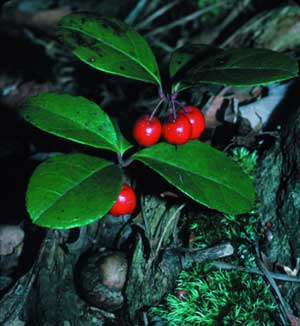
Wintergreen
The third in a multi-part series of posts about Mt. Kearsarge Indian Museum's Medicine Woods Trail.
     To understand how wild plants are regarded and used by Native Americans, it is important to understand The Circle and its central position in the Native world view.
The Circle:
People and Plants are part of the Sacred Circle.
     When visitors come to Mt. Kearsarge Indian Museum, one of the first things they do is watch an introductory video in The Silverstar Memorial Auditorium.  (For more information about Chief Sachem Silverstar and the role he played in the founding of MKIM, see our post of August 27, 2010.)
     The video begins with a quote that is attributed to Si'ahl, also known as Chief Seattle, great Chief of the Dkhw’Duw’Absh (Duwamish) people.
     "Every part of the earth is sacred to my people . . . every shining pine tree, every sandy shore, every light mist in the dark forest, every clearing . . . and every winged creature is sacred to my people.  We are part of the earth and the earth is part of us.  The fragrant flowers are our sisters.  The deer and mighty eagle are our brothers.  The rocky peak, the fertile meadows – all things are connected like the blood that unites a family."
     The circle is a very important symbol to American Indians.  It represents their belief that everything (plants, animals, people, sky, water, soil, etc.) is  interconnected – part of a circle.  The circle also represents equality to native people; in a circle, no one occupies a position greater than anyone else's.
     Circles exist everywhere in nature.  Night follows day, and day follows night.  The seasons of the year roll on in an unending cycle.  Rain falls on the soil, flows into rivers and lakes, then evaporates and forms clouds from which the rain falls again.  Life cycles of animals include eggs, young, adults, and eggs again.
Maidenhair Fern
     Since everything is interconnected, whatever happens to one part of the circle has an effect on something else.  Destroying any one thing in the interconnected circle has an effect on many others and weakens the circle.
     Indians understand that we all depend on the environment for survival, and they treat the environment with tremendous respect.  Though many of us do not live as close to nature as the early Native Americans did, we still depend on it as the sole source of the things we need for our survival.
     Native Americans have traditionally lived as part of nature, not apart from it, as we so often do today.  It has long been the custom of native people to take only what they need, and to waste nothing.
     What a powerful example North America's first people have set for us.

The Medicine Woods, Part 2

This is the second in a multi-part series that deals with Mt. Kearsarge Indian Museum's Medicine Woods Trail.  This gently winding path takes you through 2.5 acres of tranquil forest, where you will find plants that have been used by Native people as sources of food, medicine, and shelter.
++++++++++
How Plants Came to Be Used as Medicine – a legend
     One of the many American Indian origin stories says that at first animals and humans spoke the same language.  But it wasn't long before people began to mistreat the animals.  To punish the humans, the animals developed a language of their own, which the ungrateful humans could not understand.  The angry animals also created disease and spread it among the people.
     The plants, however, took pity of the sick humans and offered themselves as medicine.
++++++++++
Everything on the earth has a purpose, every disease an herb to cure it, and every person a mission.
This is the Indian theory of existence. – Mourning Dove
     (Note: Mourning Dove was a Native American author best known for her 1927 novel Cogewea the Half-Blood: A Depiction of the Great Montana Cattle Range.  The novel is one of the first written by a Native American woman and one of few early Native American works with a female central character.)
++++++++++
     Native Americans obtained medicine from plants through several methods.  Frequently the leaves of the medicinal plant were steeped in hot water and drank as tea.
     Making an infusion of the leaves or flowers of a plant is another way to extract the plant's active medicinal ingredients.  A hot infusion is made by soaking plant material in hot water for a short time.  A cold infusion is made by soaking the plant material in cold water for several hours, or overnight. 
     A cooled medicinal tea can be used as a wash.  Making a moist paste from a plant creates a poultice, which can be applied externally to the affected are.
     Finally, soaking a medicial plant in water, then boiling it down until the water has evaporated produces a decoction.
++++++++++
     Please note that the collection and use of medicinal plants is something that should only be done under the supervision of someone who has studied these plants thoroughly.  Many plants are toxic, or have toxic parts.  Some are only usable when prepared in a particular way, and have look-alikes that can fool even experts.  Even plants that are normally safe can cause allergic reations in certain people.
     In no way are the articles that will appear in this blog intended to be used as a guide to medicinal plants of the forest.  The Dream Catcher Gift Shop at Mt. Kearsarge Indian Museum has several books about the uses of medicinal plants, written by reputable authors.
     Of course, in our opinion the best way to learn about Native American medicinal plants is to visit Mt. Kearsarge Indian Museum and take a self-guided walk through the Medicine Woods.  However, please remember - doing so is only the first step in learning how to identify medicinal plants and how to use them.

Tuesday, August 2, 2011

Mt. Kearsarge Indian Museum's Medicine Woods Trail

(This entry is the first of a series dedicated to MKIM's Medicine Woods Trail.)

In 1991 volunteers reclaimed what had been a farm dumping ground in a wooded area on the grounds of Mt. Kearsarge Indian Museum and began its conversion into a tranquility zone.  More than 100 species of plants now grow on this 2.5-acre plot.  Some were sources of medicine, some supplemented the diet of the Northeast Woodlands Indians, and some provided building material from which native people built canoes, boxes, baskets, and their homes.

When visitors to the museum walk the path through Medicine Woods they are encouraged to look, listen, smell, and feel the elements of the forest.  It is our hope that they will experience what many before them have enjoyed - a sense of peace, a feeling of connection to the land, and an appreciation of its healing properties.

Native elders say that the earth not only provides teas and poultices to heal the body, but also a peace that heals the soul.  Visitors to Medicine Woods have told us that walking along the path that winds through the forest have given them a feeling of traquility.  They also remark that they leave the Woods inspired by Native philosophy not to be just takers, but caretakers of the land.
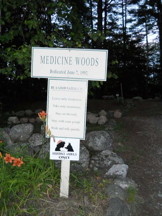
1996 Rededication of the Medicine Woods

Sunday, July 31, 2011

12th Annual Intertribal Powwow, July 9 & 10, 2011

Here's a BIG THANK YOU from all of us at Mt. Kearsarge Indian Museum to everyone who made the 12th Annual Intertribal Powwow 2011, our biggest event of the year, a success!

Over the course of the weekend 1100 spectators came to watch the dancing, listen to the singers, and tour the Museum and Medicine Woods.

Forty-two volunteers generously gave a total of 620 hours before, during, and after the Powwow.  These hard working individuals assisted with the many tasks that are required to make the event run smoothly.

Our thanks go to the 250 participants whose singing and dancing are always the very heart of the Powwow.

Legion Post 39 provided the Color Guard for the Powwow.  They carried the colors into the sacred circle at the beginning of the Grand Entry Saturday and Sunday, and retired the colors at the end of each day. Several of the native veterans present were invited to participate with Post 39.  We are grateful for their contribution.

Finally, we'd like to offer our congratulations to the head dancers for Powwow 2012.

The Head Man Dancer will be Jason Lantagne. Takara Matthews will be the Head Lady Dancer.  We are looking forward to working with Jason and Takara.  They will soon begin planning for Powwow 2012 with the Powwow Committee.

Speaking of the Powwow Committee - if you are interested in joining the committee, please call MKIM at 456-2600.  Experience is helpful, but not required.

The last tent has been put away and the last recycling bin has been hauled to the Transfer Station.  Now it's time to look ahead to our 13th Annual Intertribal Powwow.  Mark your calendars; Powwow 2012 is scheduled for July 14th & 15th.

We'll see you there!


To see more Powwow pictures, visit our Facebook Album #1 and

Our 12th Annual Intertribal Powwow, July 9 & 10, 2011

Here's a BIG THANK YOU from all of us at Mt. Kearsarge Indian Museum to everyone who made the 12th Annual Intertribal Powwow 2011, our biggest event of the year, a success!

Over the course of the weekend 1100 spectators came to watch the dancing, listen to the singers, and tour the Museum and Medicine Woods.

Forty-two volunteers generously gave a total of 620 hours before, during, and after the Powwow.  These hard working individuals assisted with the many tasks that were required to made the Powwow run smoothly.

Our thanks go to the 250 participants whose singing and dancing were the very heart of the Powwow.

Legion Post 39 provided the Color Guard for the Powwow.  They carried the colors into the sacred circle at the beginning of the Grand Entry Saturday and Sunday, and retired the colors at the end of each day. Several of the native veterans present were invited to participate with Post 39.  We are grateful for their contribution.

Finally, we'd like to offer our congratulations to the newly chosen head dancers for Powwow 2012.

The Head Man Dancer will be Jason Lantagne. Takara Matthews will be the Head Lady Dancer.  We are looking forward to working with Jason and Takara.  They will soon begin to work with the Powwow Committee, planning for Powwow 2012.

Speaking of the Powwow Committee - if you are interested in joining the committee, please call MKIM at 456-2600.  Experience is helpful, but not required.

The last tent has been put away and the last recycling bin has been hauled to the Transfer Station.  Now it's time to look ahead to our 13th Annual Intertribal Powwow.  Mark your calendars; Powwow 2012 is scheduled for July 14th & 15th.

We'll see you there!