Welcome to the Blog of the Mt. Kearsarge Indian Museum!

Thank you for visiting our blog. We hope that you will become a follower.

Mt. Kearsarge Indian Museum, Education and Cultural Center is dedicated to connecting people of today with 20,000 years of ongoing Native American cultural expression. The Museum embraces cultural diversity and encourages responsible environmental action based on respect for nature. Through exhibitions and programs, the Museum seeks to challenge and inspire all of us to improve the quality of our lives and our world.

Friday, June 8, 2012

Entries from Our Guest Book

We keep our guest book beside the main entrance at Mt. Kearsarge Indian Museum.  Some people choose not to sign it; some people write just a short comment.  All that is fine and appreciated.  But from time to time someone will write a little more, giving us some insight into what people take away with them after a visit to our museum.

[Note: Nancy and Charles "Bud" Thompson are the founders of the museum.]

May 3, 2012
We all five people enjoyed the exhibition. – Finland

May 4, 2012
Beautiful!  Very informative. – Keene, New Hampshire

May 5, 2012
Celebrate the Earth!

May 6, 2012
Amazing.  Absolutely amazing.  Thank you for preserving a truly beautiful and spiritual part of history. – Arlington, Massachusetts


May 12, 2012
We thoroughly enjoyed the museum and Medicine Woods . . . and getting to meet the founders of the museum! – Massachusetts


May 13, 2012
Thank you for a wonderful visit, and thank you, Mr. Thompson, for spending time with us.  From Sam and Jack – New Hampshire


May 15, 2012
I can't believe I waited all these years before I finally stopped.  The entire display is wonderful, and we had a terrific guide.  We'll definitely come back! – New Hampshire


May 15, 2012
The guide was terrific – very interesting.  Thanks for preserving this for us. – Pennsylvania


May 15, 2012
Superb walk-through.  Our guide had such a great wealth of knowledge and shared it all. – Massachusetts


May 17, 2012
One of the best Indian museums I have ever been through.  I really enjoyed my visit, and [I am] so glad I made a spur of the moment decision to stop by. – Tennessee


May 22, 2012
Thank you for the warm welcome and interesting introduction to Native culture. – Connecticut


May 24, 2012
Stunning!  What a treat to meet "Bud!"  I can't wait to come back. – Windham, New Hampshire


May 24, 2012
This feels like the kind of place you can't experience in just one visit.  However, my time here was one filled with great reverence and respect.  Sometime I'll come back and revisit the experience.  Maybe I'll meet Bud again (He was great this time.) – Salem, New Hampshire


May 31, 2012
I am Inupiaq.  I like learning about my heritage, and I'd like to do more research.  – Alaska

Thursday, January 12, 2012

Event This Saturday, January 14 at Peabody Essex Museum


SHAPESHIFTING: TRANSFORMATIONS IN NATIVE AMERICAN ART
Saturday, January 14, 2012 from 10am - 5pm
Location: Peabody Essex Museum
Reserve your tickets now.

9:30 amMEMBERS-ONLY GALLERY TALK –SOLD OUT

11 am and 1 pm
DOCENT-LED GALLERY TOURS.  
Meet at information desk | Tickets available on day of tour

11:45 am–12:30 pm
OPENING CEREMONY AND PERFORMANCE | Wampanoag Nation singers and dancers | atrium
Using instruments and songs passed down for generations, performers from the Wampanoag Nation share the sounds and styles of Northeastern traditional cultures.

1–2:15 pm
DISCUSSION: Changing, Knowing, Locating, Voicing: A New Look at Native American Art | 
Morse Auditorium. | For adults | Reservations by January 12
Karen Kramer Russell, curator of Native American art and culture, highlights Shapeshifting's central themes and explores the ways Native American artists respond to a wold constantly in motion. She is joined by artists Kay WalkingStick (Cherokee) and Nicholas Galanin (Tlingit/Aleut) and art historian Janet Berlo, University of Rochester, NY.
Reserve your tickets now.

1–3 pm
STUDIO SATURDAYS | Make a Drum
 – Art Studios
Design a drum that represents you or your family.

2:30–3:15 pm
PERFORMANCE | Wampanoag Nation Singers and Dancers
 | Atrium
Using instruments and songs passed down for generations, performers from the Wampanoag Nation share the sounds and styles of Northeastern traditional cultures.

3:30–5:00 pm
FILM | Reel Injun
Morse Auditorium | For adults and teens | Reservations by January 12
Reel Injun traces the evolution of cinema's depiction of Native people from the silent film era to today, with clips from hundreds of classic and recent Hollywood movies, and candid interviews with Native and non-Native film celebrities, activists, film critics and historians. 2009, 85 minutes, directed by Neil Diamond (Cree).
Reserve your tickets now.

Made possible by the Lowell Institute

Saturday, December 3, 2011

From Chief Luther Standing Bear

On the walls of the museum we have many quotes from noted Native American leaders.  Whenever we pass the words of Chief Luther Standing Bear we are reminded of the strength of the bond between native people and the earth.

"The Lakota was a true naturist – a lover of Nature.  He loved the earth and all things of the earth, the attachment growing with age.  The old people came literally to love the soil, and they sat or reclined on the ground with a feeling of being close to a mothering power.  It was good for the skin to touch the earth, and the old people liked to remove their moccasins and walk with bare feet on the sacred earth.

"The tipis were built on the earth, and their altars were made of earth.  The birds that flew in the air came to rest upon the earth, and it was the final abiding place of all things that lived and grew.  The soil was soothing, strengthening, cleansing, and healing."

Chief Luther Standing Bear spoke of days that he felt were gone forever.  His words live on nevertheless.  May our society find the wisdom to reestablish the feeling of kinship with the earth and its creatures Standing Bear described.  We may not wear moccasins or live in tipis in the future.  However, with determination, education, and hard work we may learn yet to stand with bare feet on the soil, where we will be soothed, strengthened, cleansed, and healed.

Friday, November 18, 2011

Comments From Our Guest Book

We always enjoy reading our guests' comments.  The feedback they provide is always valuable to us.  Here's what people who visited within the past few weeks had to say.


Oct. 21, 2011
A wonderful exhibit for 3rd graders!  Mt. Lebanon Elementary, West Lebanon, New Hampshire


Found this museum very interesting and informative.  Enjoyed the exhibits.  Buffalo, New York


Oct. 26, 2011
I'm glad you're here.  Very interesting.  You have the most beautiful collection of baskets and other artifacts.  It is truly wonderful that you have collected and saved these for others to appreciate.  Alberta, Canada


Oct. 28, 2011
Thank you for another wonderful field trip for our 3rd graders at Riddle Brook School.  Bedford, New Hampshire


Saw your ad in the NH Tourist's Guide while looking for things to do with friends from Germany in my home state.  We had a wonderful visit.  Thank you!  NH/Indiana/Germany


Oct. 29, 2011
What an interesting and inspirational museum.  Thank you so much.  United Kingdom


Thank you very much.  Nice to get a chance to experience the life of the TRUE Americans!  Denmark


Nov. 6, 2011
We brought two friends visiting from Guadalajara, Mexico.  Very impressed.  Thank you.  Mexico


Nov. 8, 2011
North Salem Elementary had a fabulous time!  Thank you!  Salem, New Hampshire


Nov. 12, 2011
Great museum.  And thanks for your preservation efforts.  Nebraska


Great museum!  Our son is learning about this in 3rd grade and really enjoyed this.  Amesbury, MA


Great museum.  The kids loved it (ages 4, 7, and 9 1/2)  Our oldest daughter is also studying Native Americans in school as well!  Connecticut


Nov. 15, 2011
Just great!  A nice blend of art, craftsmanship, and humanitarian values.  Will bring a few nice pictures to my old country to show around.  Belgium


Nov. 16, 2011
Very educational!  Wow!  The Native Americans are/were so smart!  Thank you so much!  New Hampshire


Wonderful.  Interesting.  Good scale makes displays approachable.  Thank you.  Very surprising!  Maryland

Wednesday, November 9, 2011

What the Children Have to Say

Recently we gave a Connect The Circle (Museum Galleries and Medicine Woods) guided tour to a group of third graders.  Earlier this week we received an envelope of thank you notes from the children.  We were pleased and impressed by what they had to say.  Here is a sampling of the comments the children wrote.  (The names have been changed.)

"Thank you for being our guide.  I liked when you showed us the Medicine Woods.  I also liked when you showed us the eel trap.  THANKS!  -Robert

"Thank you for the tour.  My favorite part was the story about the fisherman [a story learned from Bud Thompson which illustrates the native belief that everything on earth is connected and interrelated.]  I really enjoyed it! I had lots of fun!"  - Sadie

"Thank you so much for giving [our school] a tour of the museum.  It was so much fun. . . My favorite part was the story of the fishermen!"  - Grace

"QUESTIONS  How many trees do you think are at Kearsarge Indian Museum?
How many years have you [the tour guide] been working there?
What is the oldest thing you have at the museum."  - Hunter

[This card has a hand-drawn picture of Chief Passaconaway.]  "Thank you very much for touring the museum.  Love your work.  Your guest, Haley"

Thursday, October 20, 2011

Fundraising Auction and Social Oct. 22, 6:30 at Mt. Kearsarge Indian Museum

Mt. Kearsarge Indian Museum will hold its first fundraising auction and social this Saturday, Oct. 22 at 6:30 at the museum at 18 Highlawn Road, Warner, NH.  Peter Smith Auctioneer Services will be on hand for the live portion of the auction.  Silent auction tables will be set up in the museum galleries.  Refreshments will be served and there will be live music at this gala event.  

The museum recently purchased the buildings and grounds at 18 Highlawn Road that have been home to the museum for the past 21 years. This purchase will ensure that New Hampshire’s only museum and educational center devoted to the art, culture and long history of North American Indians will have a permanent home.  The first $10,000 raised in the auction will be committed to the land purchase.

Items for auction include signed limited edition artwork by Native and non-Native artists, snowshoes, a beaded cradleboard by Andrew Bullock, ash and sweetgrass baskets, silver, turquoise and beaded jewelry, dreamcatchers, a commissioned painting by Betsy Janeway, boat rental and rides, life tickets, a day in the studio of David Lamb, gift certificates to local businesses and much, much more.  See a complete listing on our website.

Admission to the auction is $10.00 for museum members and $15.00 for non-members.  Consider becoming a member today!

Tickets can be purchased at our online gift shop, or by calling (603) 456-2384.

For more information about the auction, visit our Auction Page or call (603) 456-2384.


Mt. Kearsarge Indian Museum would like to thank our generous Auction Sponsors:
Gold Sponsors: Harold and Betsy Janeway
Silver Sponsors: Virginia Theo-Steelman and David Steelman, Mascoma Savings Bank
Bronze Sponsor: Merrimack County Savings Bank


We also wish to thank our providers:
Peter Smith, Auctioneer
Schoolhouse Café, Caterers
The Cabbageheads, Musicians

Monday, October 10, 2011

Our Fundraising Auctions!

Mt. Kearsarge Indian Museum's Online Fundraising Auction is now open, with many wonderful items ready for your bids!

The Live Auction will be held October 22 at 6:30 at Mt. Kearsarge Indian Museum.  Join us for an evening of food, drinks, fun, and the chance to bid on a wide variety of fine Native or Native-related items.

We will have both a silent auction and a traditional auction that evening.

Get your tickets for the auction now - they're going fast!  Tickets are $10.00.  Call (603) 456-2384 to get yours now!

Monday, August 15, 2011

The Medicine Woods, Part 3 – The Circle

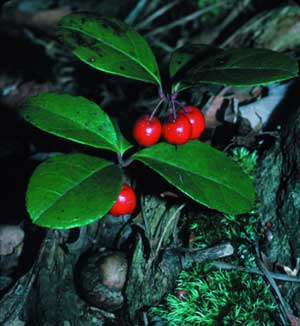
Wintergreen
The third in a multi-part series of posts about Mt. Kearsarge Indian Museum's Medicine Woods Trail.
     To understand how wild plants are regarded and used by Native Americans, it is important to understand The Circle and its central position in the Native world view.
The Circle:
People and Plants are part of the Sacred Circle.
     When visitors come to Mt. Kearsarge Indian Museum, one of the first things they do is watch an introductory video in The Silverstar Memorial Auditorium.  (For more information about Chief Sachem Silverstar and the role he played in the founding of MKIM, see our post of August 27, 2010.)
     The video begins with a quote that is attributed to Si'ahl, also known as Chief Seattle, great Chief of the Dkhw’Duw’Absh (Duwamish) people.
     "Every part of the earth is sacred to my people . . . every shining pine tree, every sandy shore, every light mist in the dark forest, every clearing . . . and every winged creature is sacred to my people.  We are part of the earth and the earth is part of us.  The fragrant flowers are our sisters.  The deer and mighty eagle are our brothers.  The rocky peak, the fertile meadows – all things are connected like the blood that unites a family."
     The circle is a very important symbol to American Indians.  It represents their belief that everything (plants, animals, people, sky, water, soil, etc.) is  interconnected – part of a circle.  The circle also represents equality to native people; in a circle, no one occupies a position greater than anyone else's.
     Circles exist everywhere in nature.  Night follows day, and day follows night.  The seasons of the year roll on in an unending cycle.  Rain falls on the soil, flows into rivers and lakes, then evaporates and forms clouds from which the rain falls again.  Life cycles of animals include eggs, young, adults, and eggs again.
Maidenhair Fern
     Since everything is interconnected, whatever happens to one part of the circle has an effect on something else.  Destroying any one thing in the interconnected circle has an effect on many others and weakens the circle.
     Indians understand that we all depend on the environment for survival, and they treat the environment with tremendous respect.  Though many of us do not live as close to nature as the early Native Americans did, we still depend on it as the sole source of the things we need for our survival.
     Native Americans have traditionally lived as part of nature, not apart from it, as we so often do today.  It has long been the custom of native people to take only what they need, and to waste nothing.
     What a powerful example North America's first people have set for us.

The Medicine Woods, Part 2

This is the second in a multi-part series that deals with Mt. Kearsarge Indian Museum's Medicine Woods Trail.  This gently winding path takes you through 2.5 acres of tranquil forest, where you will find plants that have been used by Native people as sources of food, medicine, and shelter.
++++++++++
How Plants Came to Be Used as Medicine – a legend
     One of the many American Indian origin stories says that at first animals and humans spoke the same language.  But it wasn't long before people began to mistreat the animals.  To punish the humans, the animals developed a language of their own, which the ungrateful humans could not understand.  The angry animals also created disease and spread it among the people.
     The plants, however, took pity of the sick humans and offered themselves as medicine.
++++++++++
Everything on the earth has a purpose, every disease an herb to cure it, and every person a mission.
This is the Indian theory of existence. – Mourning Dove
     (Note: Mourning Dove was a Native American author best known for her 1927 novel Cogewea the Half-Blood: A Depiction of the Great Montana Cattle Range.  The novel is one of the first written by a Native American woman and one of few early Native American works with a female central character.)
++++++++++
     Native Americans obtained medicine from plants through several methods.  Frequently the leaves of the medicinal plant were steeped in hot water and drank as tea.
     Making an infusion of the leaves or flowers of a plant is another way to extract the plant's active medicinal ingredients.  A hot infusion is made by soaking plant material in hot water for a short time.  A cold infusion is made by soaking the plant material in cold water for several hours, or overnight. 
     A cooled medicinal tea can be used as a wash.  Making a moist paste from a plant creates a poultice, which can be applied externally to the affected are.
     Finally, soaking a medicial plant in water, then boiling it down until the water has evaporated produces a decoction.
++++++++++
     Please note that the collection and use of medicinal plants is something that should only be done under the supervision of someone who has studied these plants thoroughly.  Many plants are toxic, or have toxic parts.  Some are only usable when prepared in a particular way, and have look-alikes that can fool even experts.  Even plants that are normally safe can cause allergic reations in certain people.
     In no way are the articles that will appear in this blog intended to be used as a guide to medicinal plants of the forest.  The Dream Catcher Gift Shop at Mt. Kearsarge Indian Museum has several books about the uses of medicinal plants, written by reputable authors.
     Of course, in our opinion the best way to learn about Native American medicinal plants is to visit Mt. Kearsarge Indian Museum and take a self-guided walk through the Medicine Woods.  However, please remember - doing so is only the first step in learning how to identify medicinal plants and how to use them.

Tuesday, August 2, 2011

Mt. Kearsarge Indian Museum's Medicine Woods Trail

(This entry is the first of a series dedicated to MKIM's Medicine Woods Trail.)

In 1991 volunteers reclaimed what had been a farm dumping ground in a wooded area on the grounds of Mt. Kearsarge Indian Museum and began its conversion into a tranquility zone.  More than 100 species of plants now grow on this 2.5-acre plot.  Some were sources of medicine, some supplemented the diet of the Northeast Woodlands Indians, and some provided building material from which native people built canoes, boxes, baskets, and their homes.

When visitors to the museum walk the path through Medicine Woods they are encouraged to look, listen, smell, and feel the elements of the forest.  It is our hope that they will experience what many before them have enjoyed - a sense of peace, a feeling of connection to the land, and an appreciation of its healing properties.

Native elders say that the earth not only provides teas and poultices to heal the body, but also a peace that heals the soul.  Visitors to Medicine Woods have told us that walking along the path that winds through the forest have given them a feeling of traquility.  They also remark that they leave the Woods inspired by Native philosophy not to be just takers, but caretakers of the land.
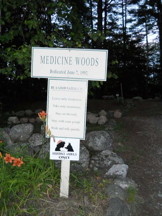
1996 Rededication of the Medicine Woods

Sunday, July 31, 2011

12th Annual Intertribal Powwow, July 9 & 10, 2011

Here's a BIG THANK YOU from all of us at Mt. Kearsarge Indian Museum to everyone who made the 12th Annual Intertribal Powwow 2011, our biggest event of the year, a success!

Over the course of the weekend 1100 spectators came to watch the dancing, listen to the singers, and tour the Museum and Medicine Woods.

Forty-two volunteers generously gave a total of 620 hours before, during, and after the Powwow.  These hard working individuals assisted with the many tasks that are required to make the event run smoothly.

Our thanks go to the 250 participants whose singing and dancing are always the very heart of the Powwow.

Legion Post 39 provided the Color Guard for the Powwow.  They carried the colors into the sacred circle at the beginning of the Grand Entry Saturday and Sunday, and retired the colors at the end of each day. Several of the native veterans present were invited to participate with Post 39.  We are grateful for their contribution.

Finally, we'd like to offer our congratulations to the head dancers for Powwow 2012.

The Head Man Dancer will be Jason Lantagne. Takara Matthews will be the Head Lady Dancer.  We are looking forward to working with Jason and Takara.  They will soon begin planning for Powwow 2012 with the Powwow Committee.

Speaking of the Powwow Committee - if you are interested in joining the committee, please call MKIM at 456-2600.  Experience is helpful, but not required.

The last tent has been put away and the last recycling bin has been hauled to the Transfer Station.  Now it's time to look ahead to our 13th Annual Intertribal Powwow.  Mark your calendars; Powwow 2012 is scheduled for July 14th & 15th.

We'll see you there!


To see more Powwow pictures, visit our Facebook Album #1 and

Our 12th Annual Intertribal Powwow, July 9 & 10, 2011

Here's a BIG THANK YOU from all of us at Mt. Kearsarge Indian Museum to everyone who made the 12th Annual Intertribal Powwow 2011, our biggest event of the year, a success!

Over the course of the weekend 1100 spectators came to watch the dancing, listen to the singers, and tour the Museum and Medicine Woods.

Forty-two volunteers generously gave a total of 620 hours before, during, and after the Powwow.  These hard working individuals assisted with the many tasks that were required to made the Powwow run smoothly.

Our thanks go to the 250 participants whose singing and dancing were the very heart of the Powwow.

Legion Post 39 provided the Color Guard for the Powwow.  They carried the colors into the sacred circle at the beginning of the Grand Entry Saturday and Sunday, and retired the colors at the end of each day. Several of the native veterans present were invited to participate with Post 39.  We are grateful for their contribution.

Finally, we'd like to offer our congratulations to the newly chosen head dancers for Powwow 2012.

The Head Man Dancer will be Jason Lantagne. Takara Matthews will be the Head Lady Dancer.  We are looking forward to working with Jason and Takara.  They will soon begin to work with the Powwow Committee, planning for Powwow 2012.

Speaking of the Powwow Committee - if you are interested in joining the committee, please call MKIM at 456-2600.  Experience is helpful, but not required.

The last tent has been put away and the last recycling bin has been hauled to the Transfer Station.  Now it's time to look ahead to our 13th Annual Intertribal Powwow.  Mark your calendars; Powwow 2012 is scheduled for July 14th & 15th.

We'll see you there!


Sunday, June 26, 2011

The Battle of the Greasy Grass

On June 25 & 26, 2011 mark the 135th anniversary of The Battle of the
General George Armstrong Custer
Greasy Grass, also known as The Battle of Little Bighorn.


The story of Custer's staggering defeat has assumed near-mythic proportions, and Custer is either glorified as a hero or vilified as the general who put his own life and the lives of his men in peril in order to achieve glory in the battle against the Sioux, the Cheyenne, and the Arapahoe that was fought near the Little Bighorn River in Montana.


There are several websites that tell the story of the battle from the Native American perspective, and at least one book that examines the events of June 25 & 26, 1876 with a careful, even approach making neither heroes nor villains of the opposing forces.


Tatanka-Iyotank, Sitting Bull
Nathaniel Philbrick's The Last Stand explores the volatile political, economic, and social forces that led to the infamous confrontation. In this carefully researched book Philbrick has produced an absorbing page-turner rich with complex characters and fast-paced action.  He demolishes commonly held myths along the way.


Smithsonian.com's "How the Battle of Little Bighorn was Won" tells the story of the battle from the Indian's point of view.


PBS.com's New Perspectives on the West offers a brief biography of Tatanka-Iyotanka, Sitting Bull (1831 - 1890), including an account of his involvement in The Battle of the Greasy Grass.


In 1991, a landmark redesignation acknowledged that the Little Bighorn Battlefield has a duel identity. More recently, in an act that was long overdue, the National Park Service established an Indian Memorial at the Little Bighorn Battlefield National Monument, which has helped to re-image the place as hallowed ground for Indians as well as whites.


NPS.gov has an online article, "Indian Memorial at Little Bighorn" which tells the story of how the Memorial came to be.


Drawing of Tashunkewitko (Crazy Horse)
No photograph of Crazy Horse
is known to exist.
An examination of "The Custer Myth", on the NativeAmerican.co.uk website is based on primary source material, including the words of George Armstrong Custer himself, Tashunkewitko (Crazy Horse,) Rain in the Face (a survivor of the battle,) General Philip Sheridan, White Man Runs Him (one of Custer's Crow scouts,) and others.


We would love to add to this list.  If you know of other web sites or books that you think are well researched, please send the link or title to us

Wednesday, June 15, 2011

MKIM Receives High Praise

     John Goff, the president of Salem Preservation, Inc., attended our Celebrate the Earth Festival May 1.  Later he wrote about his visit in the Salem (MA) Gazette, where he had some highly favorable things to say.  Here's an excerpt from the article:
     "On May 1, I was treated to a superb ash splint and sweetgrass basket-making demonstration by Abnaki Liz Charlebois at the fantastic Mt. Kearsarge Indian Museum in Warner, NH. I was impressed by that museum as well as by Charlebois’ basketry."
     You can read the entire article here.


     Salem Preservation, Inc. is a nonprofit organization. John Goff is also the principal of Historic Preservation & Design, a consulting business.

Tuesday, May 31, 2011

Exciting Events at Mt. Kearsarge Indian Museum This Weekend!


Native American Living Arts Program 


Saturday, June 4
9:00 - 1:00
Mt. Kearsarge Indian Museum
Workshop fee: $25.00

The last in our series of workshops will take place this Saturday, June 4.  The subject is Star Quilts, with workshop leader Cheryl Savageau.  
Cheryl's quilts have been exhibited at the University of New Hampshire in a contemporary Native Artists' exhibit and at the Abbe Museum's Twisting Path exhibit in Bar Harbor, Maine.


A few spaces are still available.  Please call 603-456-2600 to register.


Cheryl Savageau


Second Sunday Speaker Series
Sunday, June 5 (note: this is the 1st Sunday of the month)
1:00 - 3:00
Mt. Kearsarge Indian Museum
Admission: Free
For more information, cal 603-456-2600

Our Second Sunday Speaker Series will conclude this Sunday with Cheryl Savageau, whose topic will be Poetry, Storytelling and Cultural Survival.

Cheryl will read from her poetry and discuss the ways they relate to the land, traditional native storytelling, and the survival of Native American cultures.

Cheryl Savageau graduated from Clark University in 1978, where she began writing "by accident" when she signed up for a poetry class through Continuing Education to finish her degree, and discovered that the poetry class was actually a writing class.

Cheryl's  apprenticeship as a writer was through the People's Poets and Artists Workshop in Worcester, MA. She worked for several years as a poet and storyteller in the schools through the Massachusetts Artist in Residence program. Since 1993, she has been a member of Wordcraft Circle of Native Writers and Storytellers, working as a mentor to apprentice Native writers.

Cheryl has taught at Clark University, Holy Cross College, and the University of Massachusetts at Amherst. She is now teaching in the Native American Studies Department at the University of New Mexico in Albuquerque. Her current writing projects include a third volume of poetry and a novel about chronic illness.

The Second Sunday Speaker Series in funded by the New Hampshire Humanities Council. 

Wednesday, May 25, 2011

Turtle Island Summer Day Camp Preview

Mt. Kearsarge Indian Museum's Turtle Island Summer Day Camp begins its first week-long session Monday, June 27!

Turtle Island Summer Day Camp is where children 6 - 12 experience cultural enrichment, environmental awareness, and outdoor fun.  The camp runs from 9:00 to 3:00, five days a week, June 27 through August 5.

Six weekly sessions are offered.  Here's a preview of what is planned for each session.

Session 1: June 27 - July 1  Archaeology Week
Ancient pictures painted on cave walls, pieces of broken pottery, spear points found in local fields, are all clues from the past.  They are puzzle pieces waiting to be formed into a story.  Investigate what it's like to put those pieces together and discover stories from the people who came before us.

Session 2: July 5 - 8  The Powwow is Coming!
(There is no camp July 4)
Intertribal Powwows are a celebration of Native American culture.  Make a drum, learn a dance, enjoy flute music.  Share a behind-the-scenes look at many of the aspects of Native traditions that will be presented at MKIM's annual Powwow on July 9 - 10.  Campers receive a free pass to the Powwow!

Session 3: July 11 - 15  Land, Lore, and Animals
Habitats determine which animals can live where.  The environment also has an effect on people.  Hike to a beaver pond, trek through the trees, or dream about the desert to discover the ways the land has shaped the culture and traditions of tribes across the country.

Session 4: July 18 - 22  Spin a Story Web
Native American culture has survived in part because of the deeply rooted tradition of storytelling and lore. Stories have been passed down from generation to generation, preserving the integrity of Native culture and its connection with the natural world.  Everyone loves stories.  They open the mind and feed the imagination.  Make your own story pouch and the props that go in it, listen to guest storytellers, and perform a story of your own.

Session 5: July 25 - 29  Living Off the Land
Searching for wild foods, harvesting the garden, and preserving food for winter are important skills for Native Americans and anyone who lives close to the land.  Gather fruits of the season and discover just how many of the foods we eat were introduced by the first people of New Hampshire.

Session 6: August 1 - 5  Games and Challenges
Games can be more than fun.  They can teach important life skills, such as observation, agility, and cooperation.  Make traditional Native American games, then test your brain and body, or work as a team with others.  Make and take home toys that can extend your fun long after the week is over.

Crafts and Water Fun Every Day!  Organic Gardening Every Week!

To download and print a Turtle Island Summer Day Camp brochure and registration form, please visit http://www.indianmuseum.org/education/TurtleIslandCamp2011.htm

You can also call the museum at 603-456-2600 to request a registration form or for further information.

Financial assistance in the form of Partial Camperships are available on a limited basis.  Please call the museum for an application.

Friday, May 20, 2011

Time to Register for Turtle Island 2011 Summer Day Camp!

Mt. Kearsarge Indian Museum's (MKIM's) Turtle Island Summer Day Camp begins June 27 and runs through August 5, Monday through Friday.


Each weekly session offers campers a chance to experience Native American culture through

  • activities and games,
  • adventure and exploration,
  • storytelling, music, and art.

Each week-long session will include visits from special guests and/or Native American tradition bearers.  The staff ratio is 1 staff member for every 6 campers.  All are staff are trained instructors who have experience with children and are certified in First Aid.


Turtle Island Camp Facilities consist of a program barn which provides space for projects, as well a shelter should it rain.  Campers frequently visit the museum galleries to enhance their learning.  Outdoor exploration takes place on 10 acres of field and forest, including the Medicine Woods Trail, where over 100 plant species used Native people for medicine, food, building materials and shelter can be found. 


For more information about Turtle Island Summer Day Camp, please visit our website, or call 603-456-2600, ext. 226.  On the website you will find a downloadable camp brochure, which includes a registration form.  Discounts are offered for families who register more than one child, as well as for children who attend more than one week of camp.


Turtle Island Camp does offer Financial Assistance in the form of Partial Camperships.  This is available on a limited basis, so be sure to submit your camp registration form as soon as possible!

Thursday, May 19, 2011

A Bit of MKIM History

The following is an article written by Andy Bullock, who was a trustee of the museum.  The article is taken from The Trustees' Corner, which appeared in the Mt. Kearsarge Indian Museum Education and Cultural Center Newsletter, Vol. 11, No. 2, Summer 2001.

"On a recent trip to Mt. Kearsarge Indian Museum I was reminded of my first visit to Warner, NH.  The [museum's] founder, Bud Thompson and I drove up Route 89, passing many beautiful mountains, lakes and rivers.  Warner was, and is, such a quaint New England village.

"Bud was so excited to show me his "find" that we actually drove right past the local diner in town!  I can assure you, every trip to the museum since then has required a stop for lunch!  Like an anxious child on Christmas morning, Bud drove up the hilly road from town.  "Almost there, almost there!" he said.


MKIM Under Construction, circa 1991

"We pulled into the driveway between the house and the "barn". Keys?  Who needed keys - this was a barn after all, complete with wheelbarrows, sawdust, and pigeons living in the rafters.  Daylight was shining through the roof and the walls, as well as the windows!  Within minutes I was excited as Bud.  The pictures of where the the theater, gift shop and displays would ultimately be located had already been envisioned.  The brambles out back were the future home of "Medicine Woods".  At that time Anna's Garden was an overgrown hayfield.

"My, how far this museum has come!  Think of what Mt. Kearsarge Indian Museum means to you.  Everyone who has ever visited this museum has contributed to the spirit of this wonderful place.

"With these historic visions still in mind, I would like to welcome you back for a visit.  The snow has melted and the trees and flowers are in full bloom.  Inside the museum there are also many changes.  Several new staff members greet guests with a warm welcome.  The gift shop is stocked with an exciting selection of crafts, books and treasures.  Look at the progress of Anna's Garden.

"Be sure to notice the recent additions to the museum collection as well.  In keeping with the emphasis on Woodland cultures, two fully outfitted mannequins are now on display.  The male mannequin is dressed in an Ojibwa outfit circa 1890.  The fine detail in the floral beaded leggings and breechclout are breathtaking.  The female mannequin is dressed in a traditional Iroquois outfit.  Rows of beadwork on the leggings and skirt are reminiscent of fine European lace.  The blouse is decorated with beads, ribbon and trade silver.  The Glengarry Bonnet on her head is a superb example of 1890's Iroquois beadwork artistry.

"Catch the spirit all over again.  Take a trip to Mt. Kearsarge Indian Museum soon."

Friday, May 6, 2011

Mt. Kearsarge Indian Museum is a Yankee Magazine "Editors' Choice"!


We were very pleased to learn that Yankee Magazine has named Mt. Kearsarge Indian Museum a “Best of New England – Editors’ Choice” winner in the May/June Travel Guide to New England, which appeared on newsstands April 26.  Nearly 2 million readers nationwide read Yankee, and we are thrilled to know that MKIM is being promoted in this way.

Help us celebrate by entering Yankee’s Editors’ Choice Photo Contest.  Take a digital photo of your friends and family posing with the Editors’ Choice placard here in our lobby.  Submit the photo to Yankee Magazine’s Editors’ Choice Photo Contest by August 31 for a chance to win a 5-day getaway!

For more information, and to enter, visit www.yankeemagazine.com/contests


Opening Day and Celebrate the Earth!

Mt. Kearsarge Indian Museum opened its doors to the public for the 2011 Season Sunday, May 1.  On the same day we had our Celebrate the Earth Festival and our newest exhibit, Along the Basket Trail opened in the Northeast Woodlands Gallery.

Sunday, May 1st was a perfect day for the opening.  The sky was blue, the sun shone, and a cool breeze kept most of the black flies, the New Hampshire State Bird, away from our faces.


A variety of activities and events were presented during the Celebrate the Earth Festival.  Joan O’Connor of Henniker, owner of Joan’s Famous Composting Worms delivered an interesting and entertaining talk about red wrigglers and how they can be used to turn kitchen food waste into rich compost all year round.  Joan also had a tent on the museum grounds where she had worms on display and for sale.

Two guided tours of the Medicine Woods Trail were offered to enthusiastic attendees, and the cover was put on the tipi that stands in our field.  Liz Charlebois demonstrated the art of ash splint basket making while Denise Pouliot taught guests how to weave small fish, using ash splints.  Once the fish were completed, they were put on a string and hung from a fishing pole.  John Crawford and Steve Pitman, our accomplished chefs, had buffalo burgers for sale, while Nicole Stratton ran the Kids’ Crafts Table.

The May Second Sunday Speaker actually spoke on the first Sunday this month because the topic was a perfect tie-in to our new exhibit, Along the Basket Trail. In her presentation, Abenaki Women: Basket Making and Cultural Survival, Sherry Gould talked about the role women have played in keeping Abenaki Culture alive through basket making.  Sherry’s presentation provided an understanding of how traditional values, philosophies, history, and other aspects of the culture of a people are kept alive both by the basket makers of the past and the contemporary basket makers who continue to work with ash to produce baskets that tell the story of Abenaki people in New Hampshire.

To see pictures of the Celebrate the Earth Festival, visit our album on Facebook.